How Proplix Supports Private Rented Sector Database
The Renters’ Rights reform roadmap includes a private rented sector database phase. Proplix can help prepare property businesses by keeping landlord, property, tenancy, certificate, licence and standards information structured before external reporting or registration-style workflows become part of daily operating reality. This page explains the official compliance context in plain English and then shows how Proplix can help property teams organise the workflow, records, reminders and evidence behind it.
What UK law and official guidance says about Private Rented Sector Database
Private Rented Sector Database sits within the wider UK property compliance environment where landlords, letting agents, estate agents, property managers and housing teams need to understand the rule, apply it consistently, and keep evidence of what has been done. The official reference for this topic should always be treated as the source of truth, because property law and housing guidance can change by date, jurisdiction and type of property.
In practical terms, upcoming england prs database reform is not just a policy statement. It affects how people handle records, property information, tenant communication, landlord duties, agent responsibilities, safety evidence, application handling, service delivery and audit readiness. A property business normally needs to know who the rule applies to, which property or tenancy it affects, what information must be captured, when action is required, and how the outcome can be proved later.
The official position also needs to be read carefully because UK property compliance is not always the same across England, Wales, Scotland and Northern Ireland. Some requirements apply mainly to England, others are nation-specific, and some are UK-wide obligations such as financial sanctions, data protection or anti-money laundering controls. That means a professional property platform should not treat compliance as a generic checklist. The record needs enough context to show the property, party, jurisdiction, due date, decision, evidence and follow-up.
For Private Rented Sector Database, the most important operational question is usually whether the business can demonstrate a controlled process. If a tenant, landlord, applicant, local authority, regulator, ombudsman, internal reviewer or senior manager asks what happened, the answer should not depend on one staff member searching inboxes, downloads and spreadsheets. The business should be able to show the key dates, relevant documents, notes, responsible staff member and current status in a clean sequence.
That is why this topic belongs in a structured compliance and property operations environment. The law or guidance may describe the duty, but the day-to-day risk is normally created by missed deadlines, unclear ownership, duplicate records, weak evidence storage, inconsistent communication and poor handover between staff. Good compliance management turns the rule into an operating process that the team can actually follow.
What teams should usually keep visible
- The property, tenancy, landlord, tenant, applicant, supplier or agency record affected by this requirement.
- The relevant dates, including start date, review date, expiry date, service date, renewal date or response deadline.
- The documents, certificates, notices, declarations, communications or supporting files linked to the requirement.
- The staff member or team responsible for review, approval, follow-up, escalation and final closure.
- The audit trail showing when the record was created, changed, approved, rejected, renewed or superseded.
How Proplix supports this compliance workflow
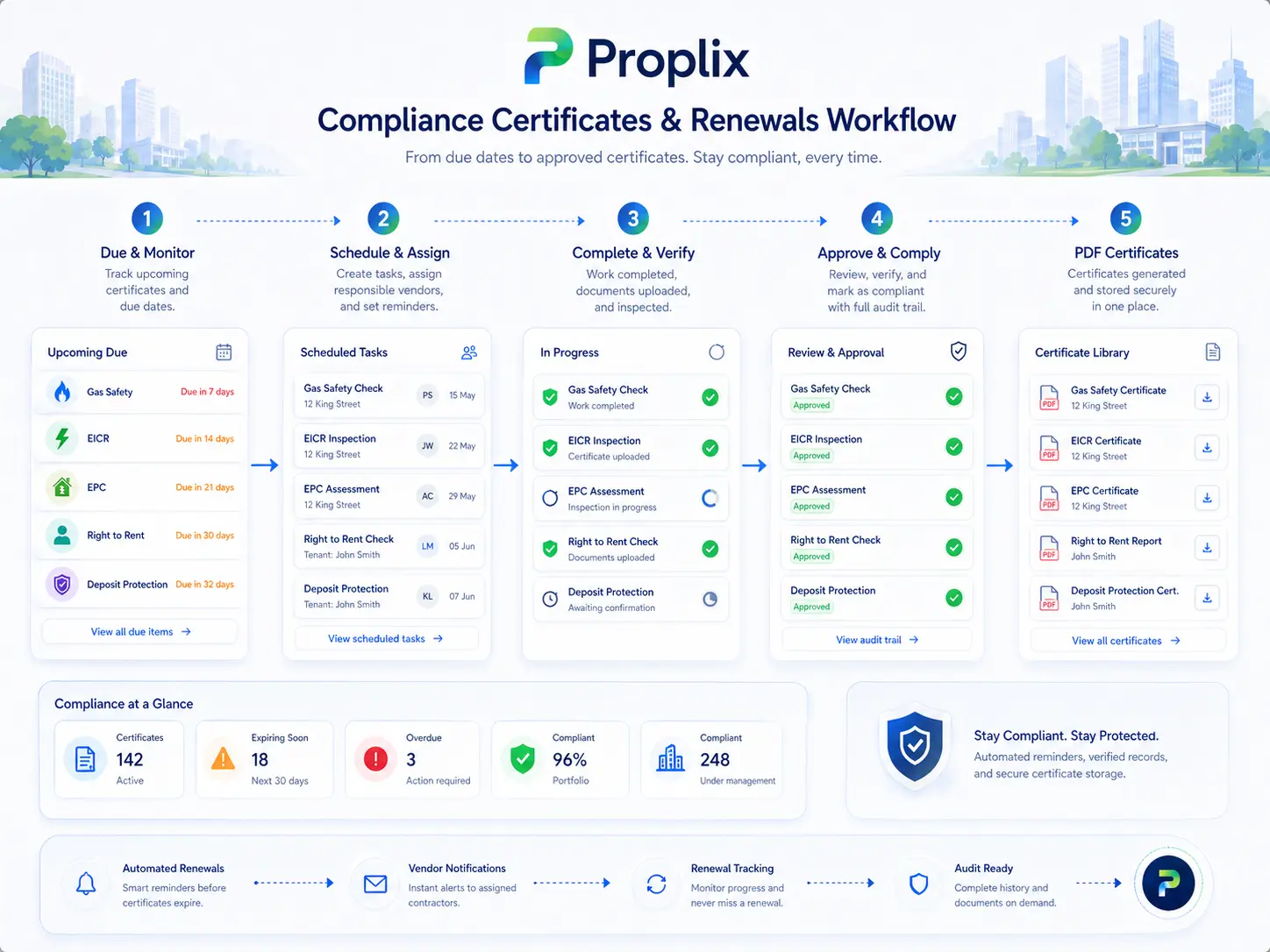
Proplix is designed to help UK property teams turn Private Rented Sector Database from a disconnected reminder into a structured operating workflow. The aim is not simply to store a document. The aim is to connect the requirement to the live property record, the right people, the right date, the right action and the evidence that proves the business handled it properly.
Inside a one-window property operations platform, this kind of compliance work becomes more useful because it does not sit alone. A record can be linked to property management, CRM, tenant onboarding, landlord visibility, maintenance, documents, portals, audit outputs and reporting. That is especially important for UK property businesses where the same event can affect several areas at once. A repair issue may become a tenant communication issue, a safety issue, a landlord approval issue, a supplier job and later an audit evidence issue.
For this requirement, Proplix can help staff capture the core record, organise related documents, record who reviewed it, preserve communication history and surface next actions. Where a certificate, notice, decision or compliance status has a deadline, Proplix can support reminders and workflow visibility so the team is not relying on memory. Where a record is approved or updated, the surrounding property, tenant, landlord or audit context can remain connected.
Proplix also helps because it supports team working. Compliance is rarely completed by one person from start to finish. One person may receive the information, another may review it, another may contact a landlord, another may allocate a supplier, and a manager may need to approve or audit the result. A professional CRM and property platform keeps those steps attached to the record, which makes the work easier to follow and easier to hand over.
For agencies and property managers, this joined-up model is commercially important. It reduces the chance of missed work, helps staff answer questions faster, improves internal consistency, and gives leadership a clearer view of risk across the portfolio. Instead of building a separate spreadsheet for every legal topic, Proplix allows the business to build one consistent operating model around properties, people, documents, workflow and evidence.
For landlords and tenants, the benefit is clearer service. Landlords can be updated with more confidence because the team can see what is complete, what is missing and what needs action. Tenants can receive better communication because requests, notices, documents and safety-related follow-up are not scattered across separate systems. Suppliers can be connected to the right job or property context where action is needed.
How Proplix can organise the flow
- Connect the requirement to the correct property, tenancy, client, landlord, tenant, supplier or agency record.
- Store the evidence in context rather than leaving documents in disconnected folders or email threads.
- Use statuses, reminders and review points to keep the team aware of missing or upcoming actions.
- Preserve notes, staff actions, approvals and updates as part of the audit history.
- Surface related workflows such as maintenance, compliance records, portals, legal audit and reporting.
- Support management visibility through structured records instead of informal manual tracking.
UK Compliance & Standards
Return to the full UK-focused compliance feature hub and explore related law and standards areas.
CRM and team workflow
See how Proplix helps teams work through tasks, records, follow-up and ownership in one platform.
Legal and audit evidence
Explore how Proplix can support approved records, audit packs, evidence continuity and regulator-ready exports.