
One-window enterprise platform
One real estate ERP for CRM, PMS, financials, property management, compliance and operations
A real estate business rarely struggles because it has too little software. It usually struggles because it has too many disconnected tools doing partial jobs. One system manages leads, another holds property records, another handles maintenance, another stores documents, another runs finance, another tracks compliance, and by the time leadership wants a clear answer, every team is working from a different version of the truth.
A real estate ERP connects the operating model rather than adding another isolated tool. Proplix brings CRM, PMS, financials, property management, maintenance, compliance, portals, workflow control and reporting into one platform where data, actions, responsibilities and evidence stay connected.
This page positions Proplix as the umbrella ERP layer: not only a CRM, not only a PMS, and not only an accounting or compliance tool. The value is in covering the whole operating model from acquisition and onboarding to live management, service delivery, financial visibility, reporting and long-term control.
Explore the ERP model in two ways
Each major ERP area below now gives you two routes. You can move into an existing relevant Proplix page to understand the wider platform story, or open a dedicated ERP guide page that explains how that capability fits into a full real estate operating model. This makes the page stronger for search, stronger for internal linking and more useful for serious buyers who are evaluating the platform at a strategic level.
ERP Module 01
CRM & Client Relationship Management
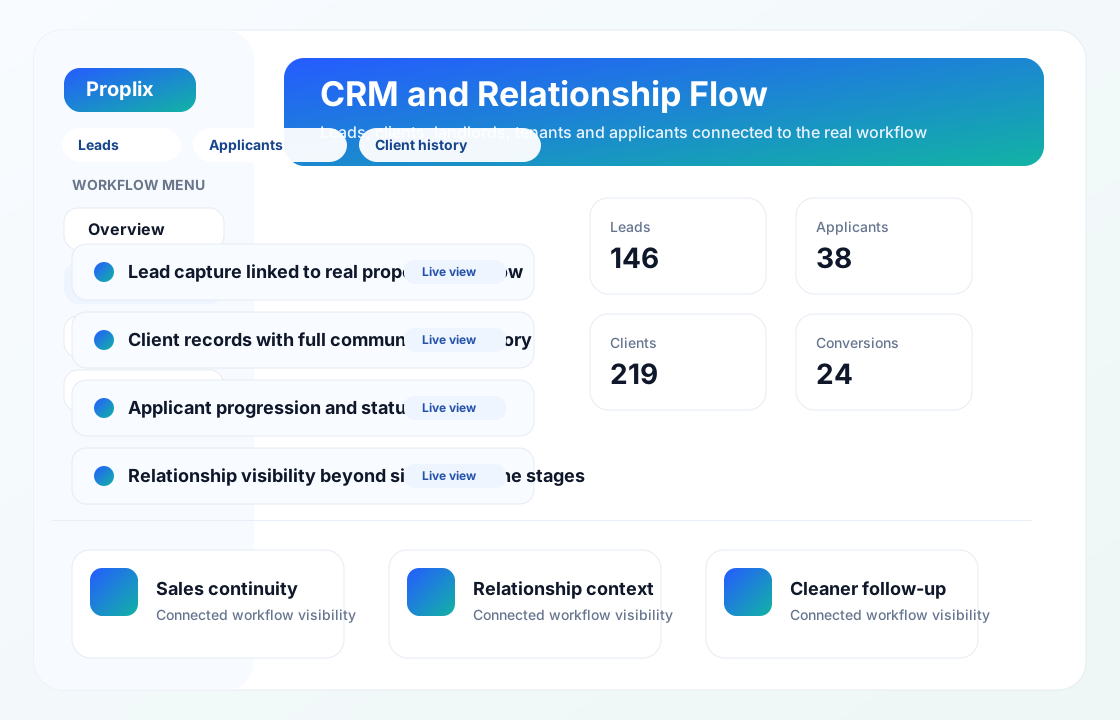
Keep leads, landlords, tenants, applicants, buyers, suppliers and full relationship history inside one ERP layer.
See related platform page
Open ERP guide
ERP Module 02
PMS & Property Operations
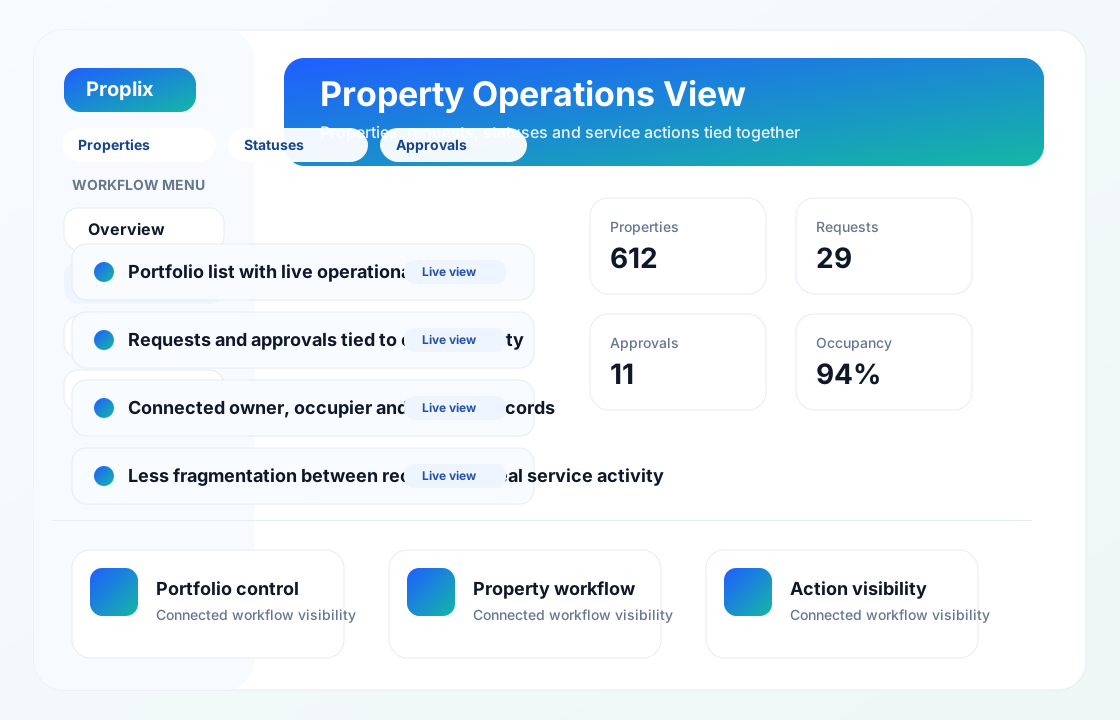
Run the day-to-day property operation from one system: properties, approvals, requests, statuses, records and service tasks.
See related platform page
Open ERP guide
ERP Module 03
Financials & Accounting
Bring invoicing, payments, expenses, revenue visibility, landlord/supplier costs and commercial control closer to live operations.
See related help page
Open ERP guide
ERP Module 04
Maintenance, Repairs & Vendor Management
Coordinate requests, jobs, suppliers, approvals, evidence and completion across one operational workflow.
See related platform page
Open ERP guide
ERP Module 05
Compliance, Risk & Evidence Management
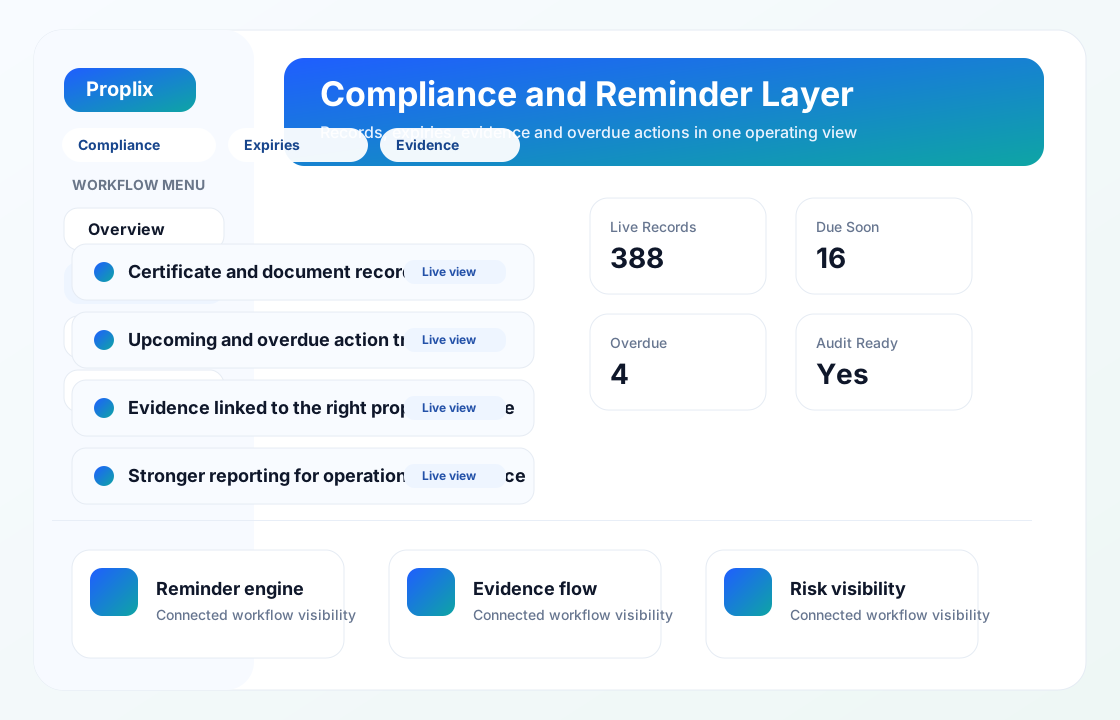
Track obligations, reminders, evidence, notices, audits and risk visibility as part of the live operating model.
See related platform page
Open ERP guide
ERP Module 06
Lettings, Tenancies & Occupancy Lifecycle
Manage applicants, offers, sign-up stages, active tenancies, renewals and occupancy changes in one connected workflow.
See related help page
Open ERP guide
ERP Module 07
Documents, Approvals & Digital Workflow
Control templates, files, letters, notices, approvals and acknowledgements as part of one digital operating process.
See related help page
Open ERP guide
ERP Module 08
Portals & Stakeholder Experience
Give landlords, tenants and suppliers the right visibility while keeping the internal operation connected to the same data picture.
See related platform page
Open ERP guide
ERP Module 09
Reporting, BI & Portfolio Performance
Turn live workflow data into dashboards, service intelligence, portfolio reporting and management decisions.
See related help page
Open ERP guide
ERP Module 10
Automation, AI & Integrations
Use reminders, workflow triggers, AI-assisted visibility and integrations to reduce manual drag and keep the platform connected.
See related help page
Open ERP guide
Why real estate businesses outgrow disconnected software
Separate apps may look manageable at the start, but property businesses grow into complexity quickly. More landlords, more tenants, more properties, more suppliers, more maintenance, more compliance obligations and more financial movement all place pressure on the operating model. What once felt manageable becomes a chain of small gaps: duplicated entries, lost context, slower approvals, weak reporting and inconsistent service follow-through.
This is why ERP positioning matters. A business does not only need a contact database or a maintenance module. It needs one coordinated digital foundation where departments can work in sequence and leadership can understand the real state of the operation at any point in time. That is the story Proplix makes clear from the first scroll onward.
01
One commercial and operational record
Sales activity, client records, property information, contracts, tasks, service activity and financial context should all be easier to trace because they belong to one operating environment instead of disconnected applications.
02
Less duplication across teams
When CRM, PMS, maintenance, compliance and reporting live together, teams do not need to rebuild the same data in multiple places or keep asking other departments for basic operational updates.
03
Stronger leadership visibility
Management can review the live business through one system: portfolio movement, client activity, maintenance load, arrears exposure, contractor performance, compliance risk and operational throughput.
04
A more scalable business model
An ERP approach matters because growth usually increases complexity. A connected platform allows the organisation to scale process, not only headcount.
What features and functionality a real estate ERP should actually include
Proplix does not hide the detail behind vague claims. Buyers want to understand what the platform covers, how it connects and why it matters. Buyers also want the same clarity when they move into the Help Centre. The dropdown sections below are written to explain the major capability areas in a humanised and practical way, while still keeping the SEO language buyers are actually searching for. Each dropdown also links deeper into both the wider site and the dedicated ERP guide page for that module.
CRM & Client Relationship Management
Every property business depends on relationships, but relationship data is often where fragmentation begins. A lead is captured in one place, the client record sits somewhere else, tenancy or ownership detail lives in another system, and once the relationship becomes operational, teams lose the commercial context that came before it. That creates a weak customer journey and an even weaker internal workflow.
Inside a genuine real estate ERP, CRM should not stop at pipeline management. It should become the front door to the wider property lifecycle. That means the same platform should help teams move from enquiry to onboarding, from onboarding to service delivery, and from service delivery to long-term account visibility without rebuilding the same records over and over again.
- Lead capture, qualification, follow-up and ownership tracking
- Landlord, tenant, applicant, buyer, vendor and supplier records
- Notes, calls, emails, meetings, tasks and internal handover history
- Relationship visibility linked directly to properties and operations
- Sales-to-service continuity without losing context or documents
PMS & Property Operations
Property management software is often treated as a separate category, but in reality it is one of the core engines of a real estate ERP. The PMS layer is where the business starts to feel live. Properties are no longer only records. They become active operating objects with owners, occupiers, requests, documents, obligations, communication history, service issues and financial relevance.
That is why a strong ERP should not only display property records. It should help teams work through the live operational flow around those properties. Whether the business is focused on lettings, block management, managed portfolios, corporate estates or mixed service delivery, the property layer should sit in the middle of the wider platform rather than in a side tool with weak links to the rest of the business.
- Property, unit, scheme and portfolio structure
- Operational statuses, approvals, notes and linked tasks
- Request handling and service movement around each property
- Owner, occupier, supplier and internal team visibility
- Document history and property-linked operational timeline
Financials & Accounting
Many property businesses do not have a finance problem in isolation. They have a finance visibility problem. Invoices exist, payments exist, supplier costs exist and portfolio performance exists, but those figures are often far enough away from the service workflow that operations teams cannot see the commercial meaning of their own work.
In a real estate ERP, financials should not feel like a separate building in another town. They should sit close enough to the operational workflow that managers can understand what is being billed, what has been paid, what is outstanding, what a supplier job has cost, what a property or account is generating, and where exposure is building. That does not mean every user sees every ledger detail. It means the financial truth is connected to the operating truth.
- Invoicing, payments and recurring billing visibility
- Expenses, credits, reimbursements and cost tracking
- Landlord, supplier and service-linked financial context
- Revenue understanding by client, property, unit or workflow
- Cleaner management reporting across operations and finance
Maintenance, Repairs & Vendor Management
Maintenance is where software promises either become credible or collapse. It is one thing to say a platform manages properties. It is another to show that it can handle incoming requests, triage them properly, assign suppliers, capture evidence, manage approvals, track progress, communicate with stakeholders and close out work with confidence.
That is why maintenance should sit at the heart of a real estate ERP rather than on the edge of it. Once a job is raised, it should be linked to the right property, the right stakeholders, the right documents, the right financial context and the right service history. If a supplier uploads photos, those updates should remain part of the case. If the landlord asks what happened, the system should have a clear answer. If leadership wants to know where work is slowing down, the reporting layer should show it.
- Request intake, triage and work-order creation
- Supplier or contractor allocation and job progression
- Approvals, images, reports and completion evidence
- Linked financial and customer context around each job
- Performance visibility across suppliers and internal teams
Compliance, Risk & Evidence Management
Property businesses do not struggle with compliance only because there are too many obligations. They struggle because the obligations are often managed outside the actual day-to-day workflow. Certificates sit in folders, reminders sit in calendars, notices sit in inboxes and leadership only sees the issue once something has already been missed. That is why compliance should be part of the ERP layer rather than a side activity.
A stronger real estate ERP should help teams see what is due, what is missing, what has expired, what evidence exists, what action is open and who owns it next. That applies across multiple kinds of operational compliance, whether the focus is safety, tenancy, governance, maintenance-related documentation or wider service obligations. The important point is not the label alone. It is whether the platform keeps the process visible and auditable.
- Recurring compliance tasks, reminders and notices
- Certificates, evidence files and audit-friendly records
- Risk visibility across properties, tenancies and service workflows
- Escalation and exception handling for overdue or missing actions
- Connected reporting for management and assurance reviews
Lettings, Tenancies & Occupancy Lifecycle
A letting or occupancy lifecycle is one of the clearest examples of why ERP thinking matters. An applicant is not only a CRM entry. They may become a tenant, a payer, a portal user, a maintenance reporter and part of the long-term property service story. If the software cannot carry that person cleanly through the lifecycle, the business ends up rebuilding context and re-entering data at every stage.
Inside a stronger real estate ERP, the lettings and tenancy flow should connect marketing interest, applicant handling, approvals, documentation, onboarding, occupancy, renewals, notices and move-out or move-on events. That does not only save time. It produces a more consistent service record and a much stronger operating history around each property and each customer relationship.
- Applicant handling, viewings, offers and progression
- Tenancy start, mid-term and renewal workflow control
- Notices, document packs and occupancy-linked reminders
- Status and timeline visibility from pre-let to move-out
- Direct linkage to repairs, financials, compliance and portals
Documents, Approvals & Digital Workflow
One of the biggest hidden inefficiencies in property operations is document sprawl. Teams generate letters, reports, statements, evidence files, tenancy paperwork, notices, approvals, signatures and email attachments every day, but too many businesses still manage them as scattered output rather than part of the workflow itself.
A stronger ERP should treat documents as live operational assets. A document should belong to the right client, property, tenancy, repair, compliance action or financial event. Approvals should not disappear into mailbox chains. Staff should know what was issued, who approved it, which template was used, whether it was acknowledged and where the final record sits. That is how digital workflow becomes more dependable.
- Template-driven letters, notices and reports
- Linked files and evidence against the right record
- Approval steps, sign-off and acknowledgement history
- Audit trail for issue, change, review and finalisation
- Cleaner document governance across departments
Portals & Stakeholder Experience
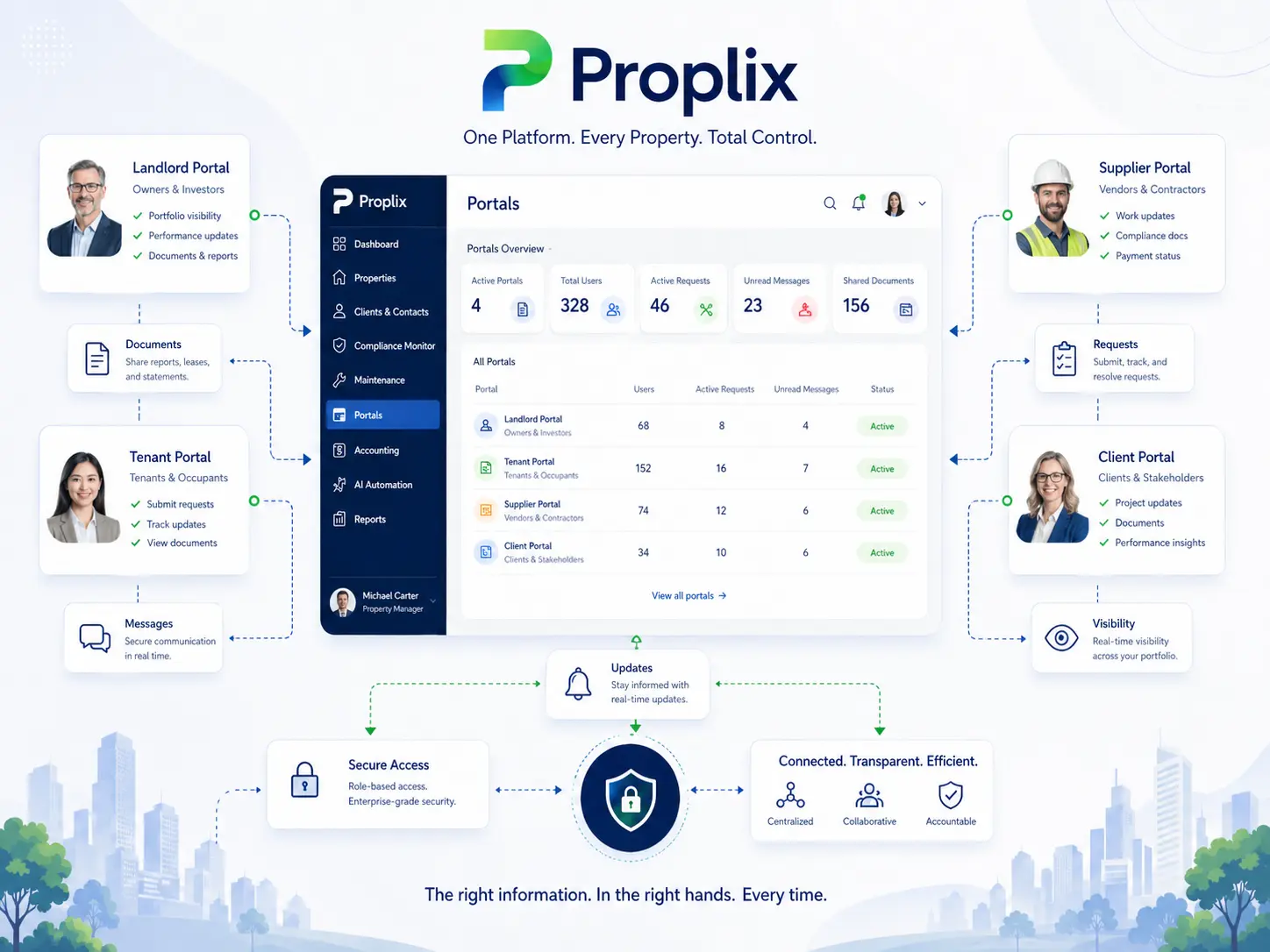
A portal is only really useful if it reflects the live operational truth of the platform behind it. Many property businesses have learned this the hard way: if the tenant portal, landlord portal or supplier portal does not match the internal workflow, the portal creates more confusion instead of less. That is why portal capability belongs inside the ERP story rather than as a separate digital add-on.
When portals are part of the same platform, stakeholders can be given the right level of access to the same underlying records, updates and document flow the internal team is already working with. That means landlords can see the right overview, tenants can follow the right service journey and suppliers can update the right jobs without forcing the business to run a second operating system in parallel.
- Landlord, tenant and supplier portal journeys
- Document visibility and controlled service updates
- Request and job-linked communication in context
- Shared operational data with role-based access control
- Cleaner external experience without fragmenting internal workflow
Reporting, BI & Portfolio Performance
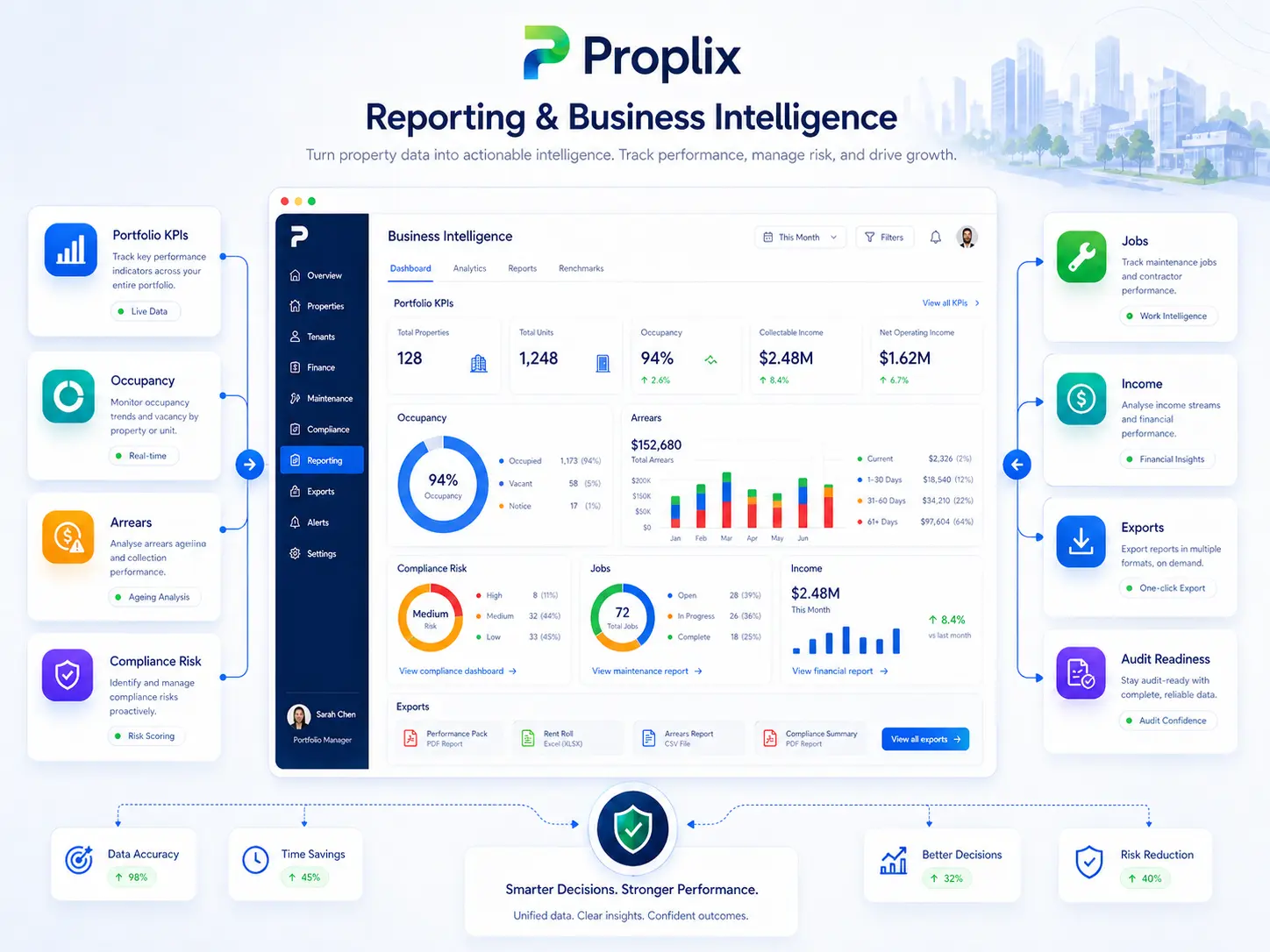
A real estate ERP becomes strategically valuable when it helps leadership understand the business as it really operates. That means reporting should not only exist for finance, or only for maintenance, or only for compliance. It should connect the real movement of the business across departments and show where performance is strong, where pressure is building and where the next intervention is needed.
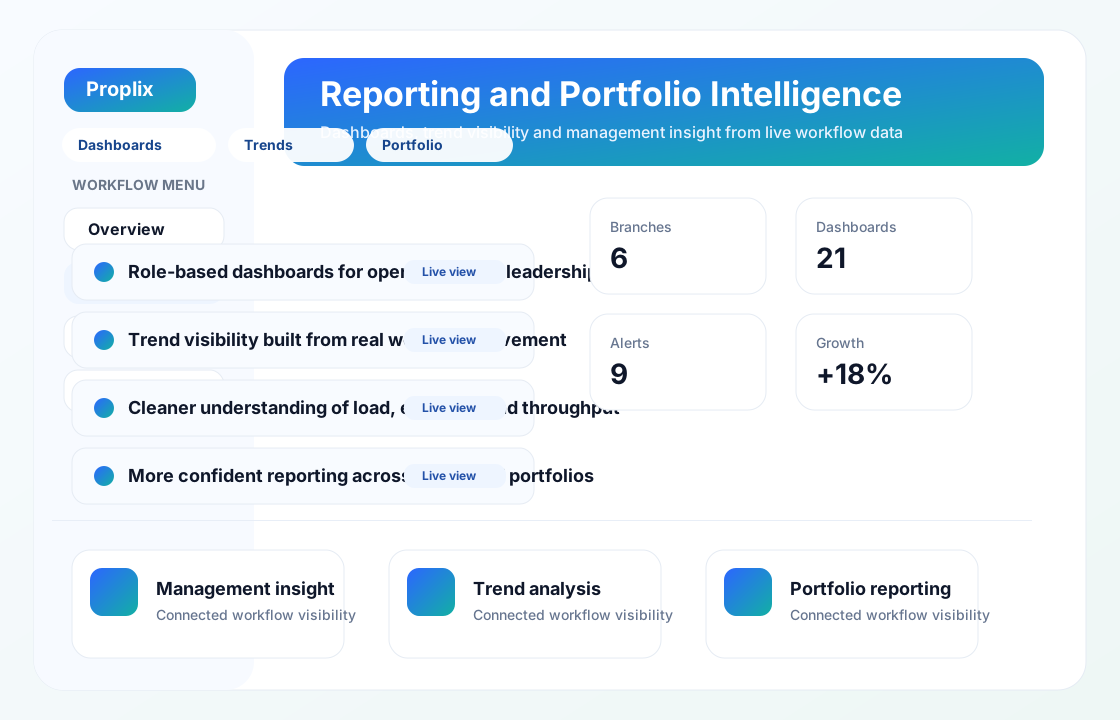
The reporting layer should therefore be more than a set of exports. It should provide role-based dashboards, operational summaries, exception views, trend analysis and management insight built from live workflow data. That allows leaders to review portfolio health, team output, compliance exposure, contractor performance, arrears, service demand and commercial movement with greater confidence.
- Role-based dashboards for frontline, managers and leadership
- Portfolio, branch, department and client-level performance views
- Maintenance, compliance, financial and service intelligence in one layer
- Exception and risk reporting built from real operational data
- Better decision-making because reports reflect the live platform
Automation, AI & Integrations
As property businesses scale, repeat work starts to consume disproportionate time. Notifications, reminders, follow-up tasks, document generation, updates, exports, handovers and reconciliations all create administration that grows faster than the headcount can comfortably absorb. That is where automation and integration become an essential part of the ERP story rather than a nice-to-have.
A stronger real estate ERP should help the business trigger actions automatically, move information between workflow stages more cleanly, connect with the right external systems and surface important case information more clearly. AI also becomes more useful in this setting when it helps summarise history, highlight overdue points, suggest next actions or improve team visibility rather than simply adding noise.
- Automated reminders, recurring tasks and stage-based triggers
- Integration hooks for connected digital operations
- AI-assisted case visibility, summaries and productivity support
- Reduced manual duplication across departments and workflows
- Cleaner scaling because process automation grows with the business
Permissions, governance and multi-branch control
A stronger real estate ERP should also support the realities of scale: departments, offices, branches, role-based access, internal approvals, restricted financial views, team ownership and accountable change history. It is not enough for the platform to store everything if every user sees too much or if leadership cannot tell who changed what and when.
That is why governance belongs inside the ERP design. The platform should help businesses manage growth without losing control over permissions, review steps, audit trail and operational responsibility.
- Role-based access and controlled visibility
- Branch, team or department-level operating control
- Audit trail across workflow, document and status changes
- Approval layers for sensitive actions and outputs
- Cleaner governance as the business scales
Why buyers search for “ERP” instead of just property software
The language shift matters. When buyers search for real estate ERP, they are often telling you that they no longer want another point solution. They want one digital operating layer that can support commercial growth, operational control, service delivery and reporting together. That is why this page should behave like an umbrella page: it should explain the whole platform clearly, connect deeper modules intelligently and give the visitor confidence that Proplix covers the business from front to back.
This umbrella view helps decision-makers assess the platform as one joined-up operating choice rather than a collection of disconnected tools.
Why the ERP story is commercially stronger than a modular story on its own
Modules matter, but decision-makers often buy the bigger picture. They want to know whether the software will help them operate more clearly, scale more cleanly and make leadership decisions with better confidence. That is why the ERP story is commercially stronger than a narrow feature story. It tells the buyer that the platform is designed to support the whole business rather than only one department.
For Proplix, that means the page should keep repeating one important message in different ways: this is the one-window operating platform that can cover CRM, PMS, financials, property management, maintenance, compliance, portals, documents, workflow and reporting together. The more clearly the page explains that, the more believable the ERP position becomes.
- CRM should feed the wider customer and property lifecycle.
- PMS should connect people, properties, workflow and service history.
- Financials should sit close enough to operations to stay meaningful.
- Maintenance and compliance should be part of the live operating layer.
- Portals should extend the same platform truth to stakeholders.
- Reporting should turn activity into leadership visibility.
The detailed ERP modules and deep pages
The cards below now act as deeper module entry points. Each one links into a dedicated page that explains how the module fits into the wider ERP model, while also linking back into the relevant existing Proplix page. This is the structure that turns a good landing page into a serious solution hub.
A
CRM & Client Relationship Management
When the CRM sits inside the ERP rather than outside it, the business gets a much stronger operating picture. Staff do not have to ask whether a person is still only a lead, already a landlord, also a supplier contact, or linked to a live tenancy or maintenance issue. The system should already know.
B
PMS & Property Operations
A stronger PMS layer reduces the gap between what the business knows commercially and what it knows operationally. That matters because property businesses usually fail in the handover between those two things.
C
Financials & Accounting
The more a business grows, the more important it becomes to connect money flow with service flow. ERP positioning becomes stronger when the platform makes that link visible instead of leaving it hidden behind separate finance tools.
D
Maintenance, Repairs & Vendor Management
The strongest maintenance workflow is not only efficient. It is accountable. That is what buyers expect from an ERP-grade platform rather than a lightweight ticket tracker.
E
Compliance, Risk & Evidence Management
ERP value increases when compliance stops being treated as a file storage problem and starts being treated as an operating control problem.
F
Lettings, Tenancies & Occupancy Lifecycle
The wider the property lifecycle becomes, the more valuable it is to manage it in one platform instead of a chain of disconnected stages.
G
Documents, Approvals & Digital Workflow
The more the business depends on repeatable communication and controlled records, the more important it becomes to bring document flow into the ERP rather than leaving it outside.
H
Portals & Stakeholder Experience
Portals strengthen the ERP proposition because they extend the same connected data model beyond the internal team.
I
Reporting, BI & Portfolio Performance
This is one of the strongest reasons to buy an ERP instead of a group of specialist tools: leadership can finally see the whole business as one system.
J
Automation, AI & Integrations
Automation matters most when it strengthens control rather than hiding it. In an ERP context, the best result is a business that feels easier to run without becoming harder to understand.
Who the Real Estate ERP page is really for
A page like this is useful because the ERP need appears in different ways across different types of property businesses. A letting agency may feel the pressure through handover and duplicated administration. A property manager may feel it through fragmented maintenance, compliance and reporting. A growing portfolio business may feel it through disconnected financial visibility. A multi-branch operator may feel it through weak management control and inconsistent reporting.
The more the website can explain that Proplix covers the whole operating picture, the easier it becomes for different buyers to recognise their own pain points inside one broader platform story.
Letting agencies
Need one system for leads, landlords, tenants, properties, maintenance, renewals, compliance and daily service workflow.
Property management firms
Need stronger portfolio control, supplier coordination, compliance visibility, resident service and financial clarity.
Landlord and portfolio businesses
Need one place to see assets, operational activity, service history, documents, compliance and income-related context.
Scaling operators and multi-branch businesses
Need a connected platform that reduces fragmentation and creates more dependable reporting and process control as the business grows.
Why this page matters for SEO and buyer confidence
There is also a strong commercial reason to build the page this way. Buyers searching for real estate ERP, property ERP, integrated property platform, CRM and PMS software, or real estate software with accounting and operations are often searching for a bigger answer than one feature page can provide. They want to know whether the platform can support the whole business model.
This page now answers that search intent more directly. Instead of forcing a buyer to guess whether Proplix can cover CRM, PMS, financials, compliance and maintenance together, the page says so clearly and then proves it through linked module pages. That improves not only search relevance but also trust, because the site is doing the work of connecting the platform story into one coherent proposition.
It also strengthens the broader internal linking structure of the site. Features pages, portal pages, compliance pages, help pages and solution pages can all point back into the Real Estate ERP page as the umbrella explanation of how the full platform fits together.
Looking for a real estate ERP instead of another disconnected tool?
Proplix is designed to give property businesses one connected platform for CRM, PMS, financials, property management, compliance, maintenance, portals, reporting and automation. If you want a more joined-up operating model rather than another standalone module, this is the conversation to have.
- Replace disconnected property software with one operating layer.
- Bring CRM, PMS, financials and service workflow together.
- Build stronger control over maintenance, compliance and documents.
- Give leadership clearer reporting across the real business, not only one department.
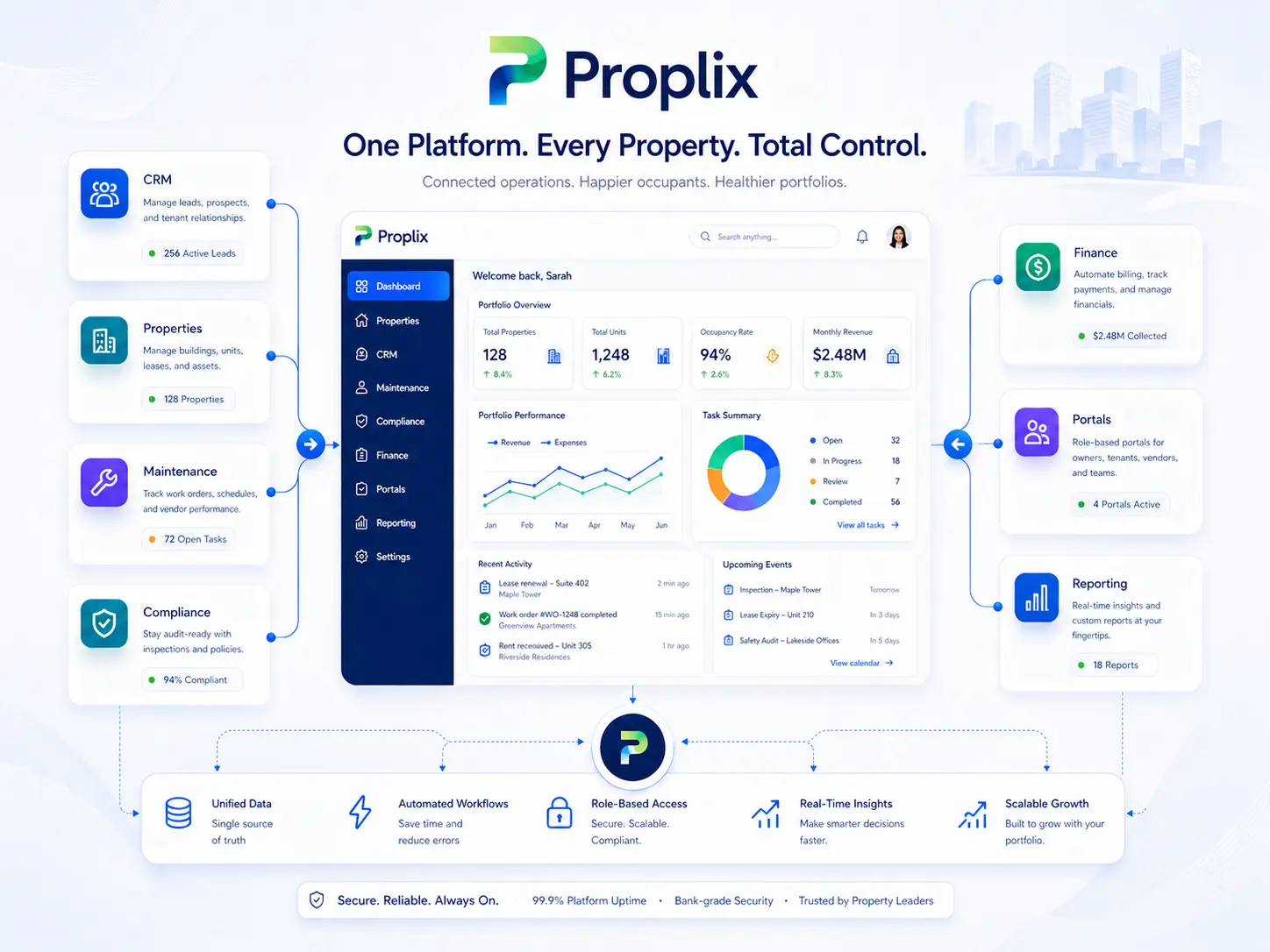
Platform illustration
A visual view of the Real Estate ERP model
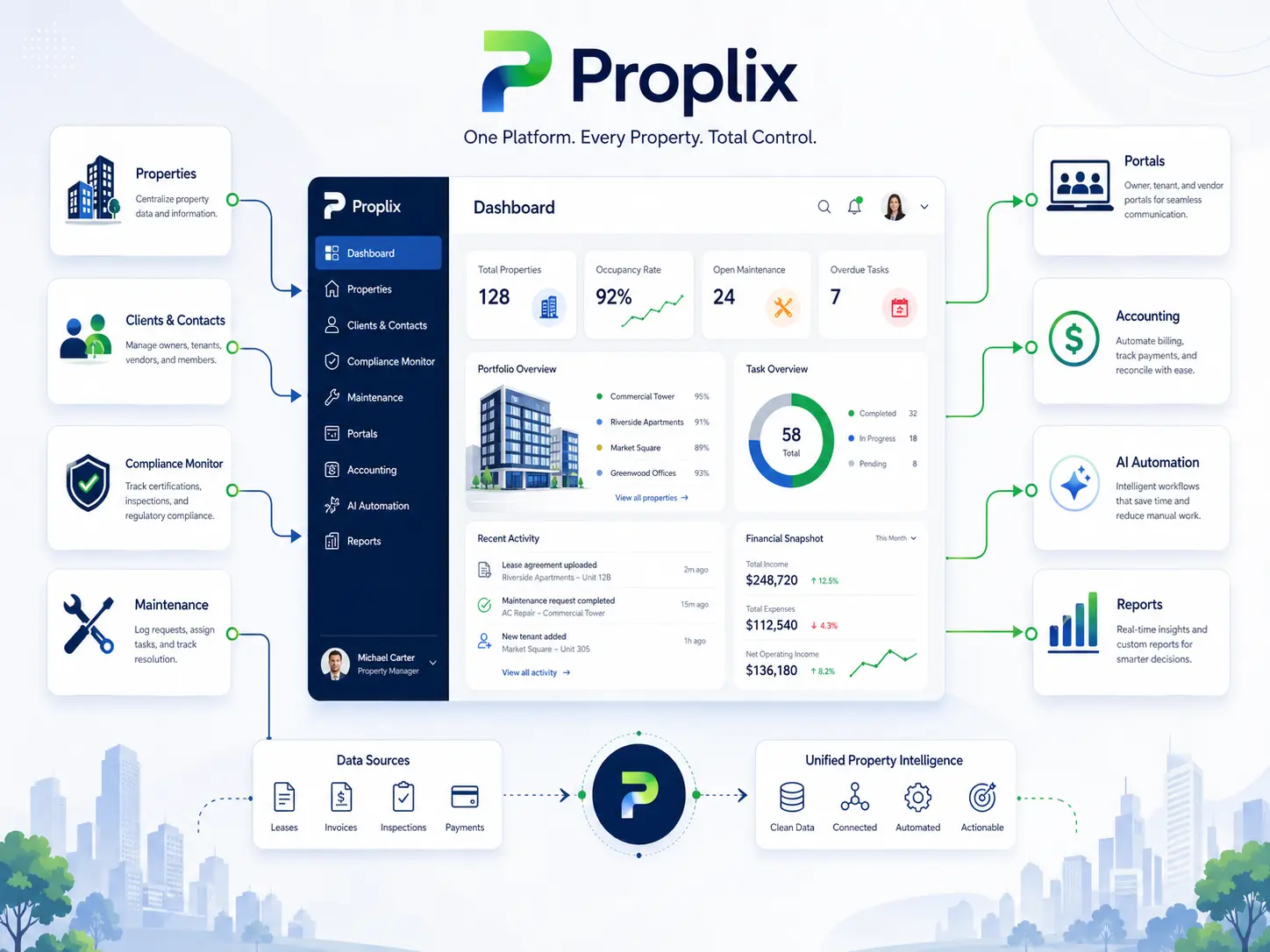
This illustration reinforces the ERP story behind Proplix: CRM, PMS, financials, maintenance, compliance, documents, portals and reporting should work as one connected business system rather than as separate software islands.
Designed around the operating model
How Real Estate ERP fits into dependable property operations
The strongest starting point is the work people actually complete, including the exceptions that rarely appear in a process diagram. Organisations may use similar property records while running very different services. The right solution reflects who owns each decision, how work moves between teams and what clients, residents, landlords or partners genuinely need to see.
Give each role enough context to act
Front-line teams need fast access to the current position, managers need an honest view of workload and risk, and external users need controlled visibility that reduces unnecessary chasing. Each audience should see the same underlying operation through an appropriate role-aware view. For Real Estate ERP, that means access should follow an evidenced business need and change when responsibility changes.
Keep the reason beside the action
Service quality often weakens at the handover between enquiry, instruction, tenancy, maintenance, finance and compliance. Connecting those stages makes responsibility visible and helps the next person understand what has already happened before taking action. This makes the Real Estate ERP record more useful during absence, escalation, service review or a later audit.
Design for the case that does not fit
Property work includes incomplete forms, late evidence, changed instructions, unavailable suppliers and circumstances requiring discretion. The system should expose those exceptions, preserve notes and direct them to an authorised person instead of silently forcing a misleading “complete” status.
Configure from representative work
A rollout works best when the organisation agrees its operating language, record ownership and exception routes before configuring screens. Pilot work should involve the people who complete the process, not only those who receive the final report. Document what remains outside the system as well, so teams understand the boundary between Proplix, connected services and professional responsibility.
Measure whether the work is improving
Useful measures include response consistency, outstanding actions, repeat data entry, time lost locating evidence and the quality of updates supplied to stakeholders. Those indicators show whether the operating model is becoming easier to manage. Review findings with the people completing Real Estate ERP work, because a dashboard may not reveal the manual workaround being used beside it.
Keep guidance, permissions and records current
Ownership, legislation, services and internal policies change. Schedule periodic checks of access, templates, notifications, integrations and retained information. Record material changes and brief affected users so the configured workflow continues to reflect the organisation’s approved way of working.
Proplix supports structured workflow and evidence handling; it does not provide legal advice or remove the need for competent human review. Discuss your organisation, migration or integration requirements through the central secure enquiry route.
Discuss Real Estate ERP requirements →Plan your next step
Bring a typical case, the systems you use and the main problem you want to solve. Together we can map the records, responsibilities and checks needed for a useful first release.
Explore software integrations, compare enterprise modules or discuss a custom property workflow. The agreed scope will explain what is included, what needs configuration and how your team will be supported.