
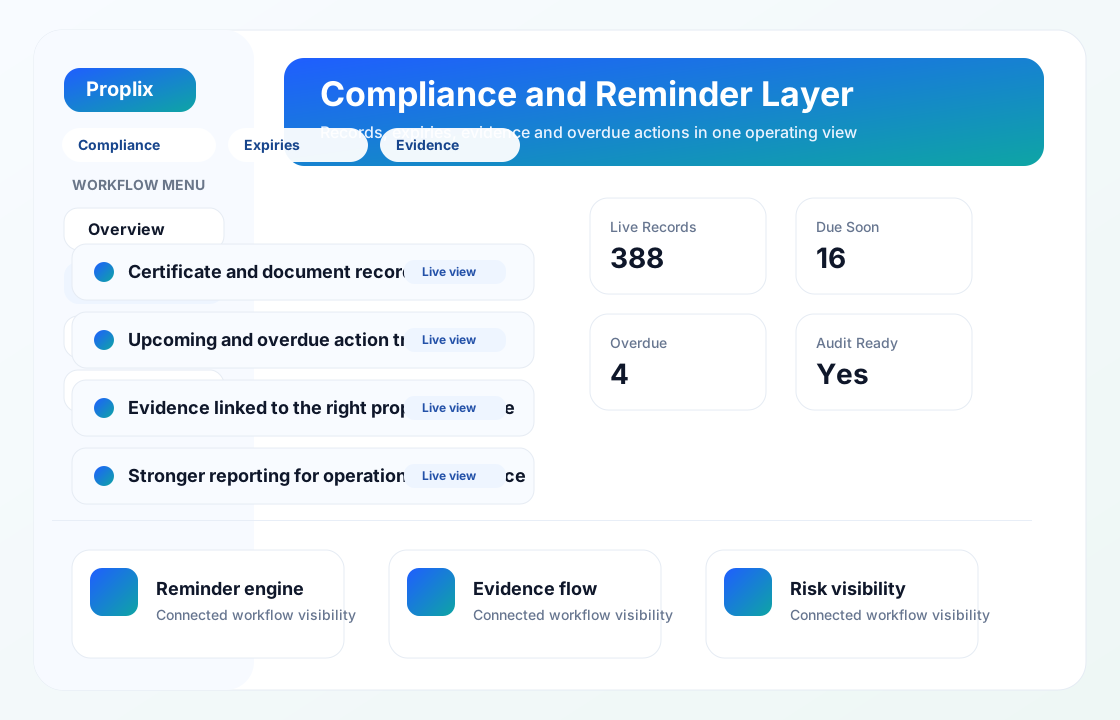
Compliance & audit in one place
One compliance window for property, tenancy, governance and audit workflow
The Proplix compliance area is designed to feel like a serious operating layer rather than a scattered list of documents and reminders. It brings together the major compliance and governance areas reflected across the software story, helping property businesses keep records, evidence, workflow and organisational oversight in one connected place.
Instead of treating each compliance duty as a separate administrative burden, Proplix demonstrates how the full compliance environment fits inside one wider property platform. That means safety records, tenancy workflow, due diligence, governance and organisation-level compliance can all be viewed as part of the same professional operating model.
What this landing page gives you
A dedicated route into every major compliance area already represented in the software story.
Read more buttons that take visitors into detailed pages for each compliance topic.
A clearer way to present Proplix as one window for compliance, governance and operational control.
A stronger corporate structure for future content expansion across the website.
Safety & Property
Explore the compliance areas within this group and move into the dedicated pages for a fuller explanation of how each area fits into the Proplix one-window operating model.
GAS
Gas Safety / CP12
Gas certificates, expiry visibility and operational follow-through. Gas Safety and CP12 compliance should feel like part of a live operational process rather than a disconnected reminder. Proplix is positioned to help property businesses keep certificate visibility, record status, workflow actions and renewal awareness in one place so the wider team can work with more confidence.
EIC
EICR / Electrical Safety
Electrical inspection workflow, record visibility and evidence handling. Electrical safety should sit inside the same structured operating environment as the rest of the property workflow. Proplix explains how EICR handling can be supported through better visibility over report status, evidence, review notes and operational follow-through.
EPC
EPC / Energy Performance Certificate
Energy certificate visibility, status awareness and property readiness. EPC handling works as part of a broader property readiness and compliance workflow. Proplix demonstrates how certificate status, document visibility and related property context can stay inside one operating environment.
HMO
HMO / Licensing
Licensing visibility, record control and governance support. HMO and licensing obligations often create ongoing administrative pressure because they involve documents, approvals, dates, evidence and local authority related context. Proplix demonstrates how this can be handled more clearly through one coordinated compliance workflow.
Tenancy & Occupancy
Explore the compliance areas within this group and move into the dedicated pages for a fuller explanation of how each area fits into the Proplix one-window operating model.
DEP
Deposit Protection
Deposit evidence, process control and tenancy workflow visibility. Deposit protection is a practical tenancy compliance area where process visibility matters. Proplix explains how the platform helps keep evidence, workflow status and record context connected so that teams can manage the process more clearly.
RIG
Right to Rent
Occupancy checks, record visibility and evidence-led workflow. Right to Rent handling works as a documented workflow rather than a simple checklist. Proplix demonstrates how record visibility, supporting documents, review outcomes and linked tenancy context can stay inside one connected environment.
AML
AML / KYC & Sanctions
Due diligence, risk review and evidence-led onboarding support. AML, KYC and sanctions-related workflow works as a structured due diligence process rather than a fragmented collection of checks. Proplix helps businesses keep evidence, review context and workflow visibility connected in one place.
Governance & Data
Explore the compliance areas within this group and move into the dedicated pages for a fuller explanation of how each area fits into the Proplix one-window operating model.
GDP
GDPR Retention & Data Protection
Data governance, retention awareness and process visibility. GDPR retention and data protection works as a governance workflow rather than a hidden administrative concern. Proplix helps businesses manage visibility, review context and operational discipline around data handling in one place.
ICO
ICO Data Protection Fee / Registration
Registration visibility, supporting evidence and governance control. ICO registration and data protection fee handling form part of the wider governance layer inside Proplix, keeping registration status, record evidence and operational awareness easier to follow.
MAT
Material Information
Disclosure visibility, property context and record discipline. Material information handling works as a structured property disclosure workflow rather than a disconnected content task. Proplix demonstrates how this can be supported through better visibility around property context, record handling and operational responsibility.
Agency Governance & Financial Assurance
Explore the compliance areas within this group and move into the dedicated pages for a fuller explanation of how each area fits into the Proplix one-window operating model.
CLI
Client Money Protection
Governance visibility, evidence control and organisation-level assurance. Client Money Protection works as part of the wider governance framework inside Proplix. the platform keeps organisational records, supporting evidence and compliance-related visibility easier to manage.
RED
Redress Scheme Membership
Membership visibility, evidence handling and organisation-level governance. Redress Scheme Membership forms part of a wider organisational governance framework. Proplix demonstrates how evidence, membership visibility and related workflow context can stay clearer and more accessible inside one platform.
EST
Estate Agency AML Supervision
Supervision visibility, governance records and evidence control. Estate Agency AML Supervision works as part of a governance-aware compliance environment. Proplix helps businesses keep supervision-related visibility, evidence and supporting records in one clearer operating system.
LAN
Landlord Ombudsman
Membership visibility, supporting records and governance readiness. Landlord Ombudsman related workflow forms part of the wider compliance and governance structure inside Proplix. The aim is to explain how evidence, organisational records and operational visibility can stay better connected.
Why this compliance model matters
Property businesses often struggle because compliance information is split across inboxes, spreadsheets, documents and separate systems. That weakens visibility and makes it harder to maintain a confident picture of what exists, what has been reviewed and what needs attention next. Proplix treats compliance as part of one connected platform so that day-to-day property operations, evidence handling and organisation-level governance can remain easier to follow.
01
One source of truth
Bringing compliance records, property context, tenancy workflow and governance evidence into one environment helps teams reduce fragmentation and work with more confidence.
02
Stronger operational visibility
When compliance lives next to the rest of the operating workflow, it becomes easier to understand what is current, what is pending and where supporting evidence sits.
03
Better corporate positioning
A dedicated compliance landing page and detailed compliance routes help Proplix look like a serious platform for regulated property operations rather than a basic add-on system.
Compliance module depth
A fuller view of the Compliance Monitor structure for real estate operations
The compliance landing page should do more than list topics. It should help a buyer understand how the full Compliance Monitor works as an operating environment for evidence, approvals, risk visibility, tenancy workflow, legal governance and audit-ready reporting. In real estate, compliance is rarely one isolated task. It sits across people, properties, notices, records, document handling, service chronology and managerial oversight, which is why the platform needs to be described as a connected system rather than a basic reminder tool.
This added section maps the module more deeply so agencies, property managers and landlords can see how the major areas fit together. Each dropdown below explains a dedicated compliance heading in more practical and more human language, focusing on how the workflow supports real property operations instead of treating compliance as a disconnected admin exercise.
Gas Safety / CP12 Tracking
Gas safety management becomes far more reliable when certificates, review work, approved records and expiry visibility sit in one controlled workspace instead of being scattered across email chains and folders.
- Certificate intake and review visibility
- Linked property context and record continuity
- Approval-led trusted record creation
- Renewal and expiry awareness
- Controlled handling of corrections or deletions
- Cleaner operational follow-through
- More reliable evidence posture
- Stronger portfolio confidence
EICR Tracking
EICR workflow should help teams understand electrical safety status clearly across the portfolio, keep supporting records intact and reduce the risk of important renewals being handled reactively.
- Electrical certificate status visibility
- Property-linked evidence continuity
- Review and approval support
- Expiry monitoring and forward awareness
- Cleaner record organisation
- Improved manager oversight
- Better long-term safety control
- Stronger audit support
EPC / MEES Tracking
EPC and MEES handling should help the business keep energy-related compliance visible and tied to the right property records so renewal, review and decision-making become easier to manage.
- Energy certificate visibility
- Property-linked status handling
- MEES-sensitive oversight
- Review continuity and supporting records
- Cleaner renewal planning
- Better operational awareness
- Reduced fragmented admin
- Improved reporting value
Deposit Protection Workflows
Deposit protection should be treated as a tenancy compliance workflow with clear evidence, service continuity and a better record of how the business handled the obligation over time.
- Deposit-related record continuity
- Tenancy-linked evidence visibility
- Service and chronology support
- Approved-record handling
- Clearer internal follow-up
- More reliable audit context
- Reduced tenancy fragmentation
- Stronger compliance discipline
Right to Rent Workflow
Right to Rent needs stronger document organisation and easier evidence visibility so teams can keep the workflow clear without losing the wider tenancy context.
- Identity and evidence handling
- Tenant and tenancy-linked context
- Review-oriented workflow support
- Document continuity and chronology
- Cleaner internal reference value
- Reduced evidence sprawl
- Better tenancy compliance posture
- Stronger audit readiness
AML / KYC Support
AML and KYC support should help property businesses organise verification-sensitive workflow more professionally, with clearer record continuity and better operational confidence around the evidence held.
- Verification workflow structure
- Evidence and document visibility
- Linked-record continuity
- Better governance support
- Improved internal oversight
- More structured risk handling
- Reduced fragmented verification admin
- Stronger business discipline
GDPR Retention / Deletion Controls
GDPR handling becomes more credible when retention awareness, deletion control and governance-sensitive record decisions sit inside a clearer operational structure.
- Retention-aware record handling
- Deletion-control support
- Governance-sensitive workflow structure
- Data lifecycle visibility
- Improved accountability context
- Cleaner internal process discipline
- Reduced ad hoc data handling
- Stronger governance posture
HMO / Licensing Tracking
HMO and licensing work should help the business keep licence status, supporting records and follow-up actions visible enough to manage them proactively rather than reactively.
- Licence status visibility
- Property-linked record continuity
- Supporting evidence organisation
- Renewal and follow-up awareness
- Cleaner internal oversight
- Improved licensing discipline
- Better portfolio-level confidence
- Stronger management visibility
Alarms / Fire / Legionella Checks
Safety-related checks should sit in a controlled compliance environment where rechecks, supporting evidence and property-linked history are easier to follow over time.
- Safety-check record handling
- Inspection visibility and chronology
- Recheck awareness where relevant
- Property-linked evidence support
- Cleaner internal follow-up
- Improved safety oversight
- Better manager awareness
- Reduced fragmented monitoring
Client Money / Accounting Separation Monitoring
Client money and accounting separation should reinforce governance clarity and help the organisation present a more disciplined operating model around financial trust and responsibility.
- Governance-led monitoring support
- Policy and record visibility
- Improved internal oversight context
- Cleaner accounting-separation awareness
- Reduced governance fragmentation
- Better trust signals
- More mature internal control language
- Stronger audit support
HMRC / MTD Related Workflows
HMRC and MTD-related workflow should help teams keep reporting-sensitive records better structured and easier to explain across the operational and governance picture.
- Reporting-sensitive workflow awareness
- Record continuity and internal reference value
- Improved obligation visibility
- Cleaner governance support
- Better financial workflow organisation
- Reduced fragmented record handling
- Improved management confidence
- More mature operational readiness
Tenant Fees / Permitted Payments
Tenant fees workflow should support evidence-led handling so the business can preserve the logic, documents and tenancy context behind each relevant compliance decision.
- Fee-related evidence support
- Rule-aware tenancy workflow structure
- Supporting record continuity
- Review-oriented handling
- Clearer evidence posture
- Improved audit support
- Reduced manual ambiguity
- Stronger tenancy discipline
Tenant Information & Prescribed Documents
Tenant information handling should make service evidence, prescribed document history and tenancy-linked records easier to follow across the life of the tenancy.
- Service-evidence support
- Served-record continuity
- Tenancy-linked compliance flow
- Improved chronology value
- Reduced evidence fragmentation
- Cleaner internal handling
- Better future reference
- Stronger tenancy compliance posture
Possession & Notice Compliance
Possession and notice handling should support a more controlled workflow around notices, review, evidence and eventual reporting or challenge, rather than leaving important records scattered.
- Notice-related workflow visibility
- Review and approval continuity
- Supporting record preservation
- PDF and evidence value
- Chronology-aware handling
- Cleaner tenancy progression context
- Improved operational discipline
- Stronger evidence posture
Rent Increase & Bidding
Rent increase and bidding workflow should help the team manage commercially sensitive changes with clearer status visibility, supporting context and better continuity of decision records.
- Status-led workflow support
- Tenancy-linked continuity
- Supporting evidence visibility
- Improved operational consistency
- Commercial context organisation
- Clearer internal handover
- Reduced manual uncertainty
- Better oversight value
Pet Requests Compliance
Pet request handling should help teams track the request, preserve the supporting reasoning and maintain a stronger history around communication and final decision-making.
- Request status visibility
- Decision continuity and reasoning context
- Supporting evidence handling
- Notification-aware workflow support
- Tenancy-linked record structure
- Reduced fragmented communication
- Improved operational memory
- Stronger decision trail
Legal & Audit Hub
Legal and Audit should sit on top of approved records so the business can turn operational compliance work into clearer audit selection, evidence handling and regulator-ready output.
- Approved-record consumption model
- Audit-area organisation
- Cleaner evidence preparation
- Authority-facing pack support
- Reduced duplication of live workflow
- More structured reporting readiness
- Improved compliance confidence
- Stronger business maturity
Legal Governance Register
Legal Governance Register should help the organisation keep governance-sensitive obligations visible in one place and easier to relate back to the wider compliance and audit picture.
- Governance record visibility
- Obligation-aware monitoring support
- Improved legal oversight context
- Structured governance continuity
- Better reporting support
- Reduced governance fragmentation
- Stronger internal awareness
- More disciplined legal posture
Agency Governance headings
The governance side of the module should help the business keep redress, ICO, AML supervision, landlord ombudsman and related obligations easier to reference and explain internally.
- Redress Scheme Membership
- ICO Data Protection Fee Registration
- Estate Agency AML Supervision
- Landlord Ombudsman
- Material Information
- Cleaner governance grouping
- Improved internal reference value
- Stronger corporate trust signals
Audit Trail & Chain of Custody
Audit trail and chain of custody matter because compliance becomes more defensible when approvals, snapshots, source references and significant actions are preserved clearly over time.
- Traceability and chronology support
- Snapshot and source continuity
- Improved audit evidence value
- Stronger authority-ready posture
- Cleaner long-term record memory
- Reduced uncertainty around change history
- Better management confidence
- More mature platform architecture
Authority Reporting, Evidence Bundles & Audit Output
The authority and reporting side of the module should help approved records become usable outputs for audits, official packs, evidence bundles and regulator-facing reporting requirements.
- Approved-record reporting output
- Evidence-bundle readiness
- Authority-facing pack support
- Cleaner audit-area organisation
- Improved regulator-facing confidence
- Reduced duplicated effort
- Better business reporting maturity
- A more complete compliance platform proposition
Why the compliance landing page matters
The compliance landing page is where the buyer should understand that Proplix is not describing isolated certificates or notices. It is describing a fuller property compliance operating system with evidence, review, governance and reporting value.
- Shows the breadth of the Compliance Monitor
- Connects safety, tenancy and governance topics
- Helps visitors understand operational depth
- Supports a stronger buyer journey
- Improves portfolio risk understanding
- Strengthens brand credibility
- Reinforces the one-window platform message
- Supports better commercial confidence
Compliance for property businesses
Real estate compliance needs one place for records, workflow, evidence and management confidence
For real estate businesses, compliance is not only about whether a document exists. It is about whether the organisation understands its current position clearly, whether approved records are trusted, whether notices and tenancy evidence are easier to follow, and whether the business can respond confidently to internal review, landlord questions or authority-facing requests. That is why the compliance landing page should carry more depth than a simple list of headings.
When compliance is structured properly, it improves more than audit readiness. It improves operational clarity, supports stronger handover between staff, reduces fragmented administration and gives the business a more professional service posture overall. That is the broader value the compliance landing page should now communicate more clearly: one connected environment for property safety, tenancy obligations, governance-sensitive records, evidence continuity and long-term operational control.
Frequently asked questions
Frequently Asked Questions
Practical answers to common questions from UK letting agents, landlords, property managers and operational teams evaluating this area of Proplix.
What does Compliance involve inside Proplix?
The compliance pages are written to show how Compliance fits into a more connected operating environment with better visibility, evidence handling and workflow control.
Why is compliance treated as part of the wider platform?
Because in real operations compliance does not sit on its own. It connects to property records, workflow, communication, evidence and accountability.
Will this help with day-to-day compliance handling?
Yes. Connected records, evidence and workflow make compliance activity easier for authorised teams to follow and manage.
Is this page only about documents?
No. The compliance pages are meant to explain visibility, process, supporting evidence and operational follow-through, not only document storage.
How does this route support daily workflow and decision-making?
Because compliance depends on more than a document name. Teams need to understand the record, evidence, status, responsibility and operational follow-through.
How does this help British property businesses specifically?
Yes. Proplix is designed around the practical responsibilities faced by UK agencies, property managers, landlords and related organisations.
Can this reduce fragmented admin?
Yes. The compliance pages reinforce the idea that keeping records and process in one connected environment reduces fragmentation and improves oversight.
Does this connect with wider Proplix workflows?
Yes. Each compliance page supports the wider Proplix story by linking the topic back to workflow, service delivery, portals and operational visibility.
Which related workflows should I review?
It is often useful to review the wider compliance landing page, related feature pages and the commercial proposal process so you can understand both the workflow value and the implementation fit.
Why is Proplix presenting compliance this way?
Because the product is being positioned as a serious operating platform rather than a simple reminder tool, and compliance is an important part of that wider identity.
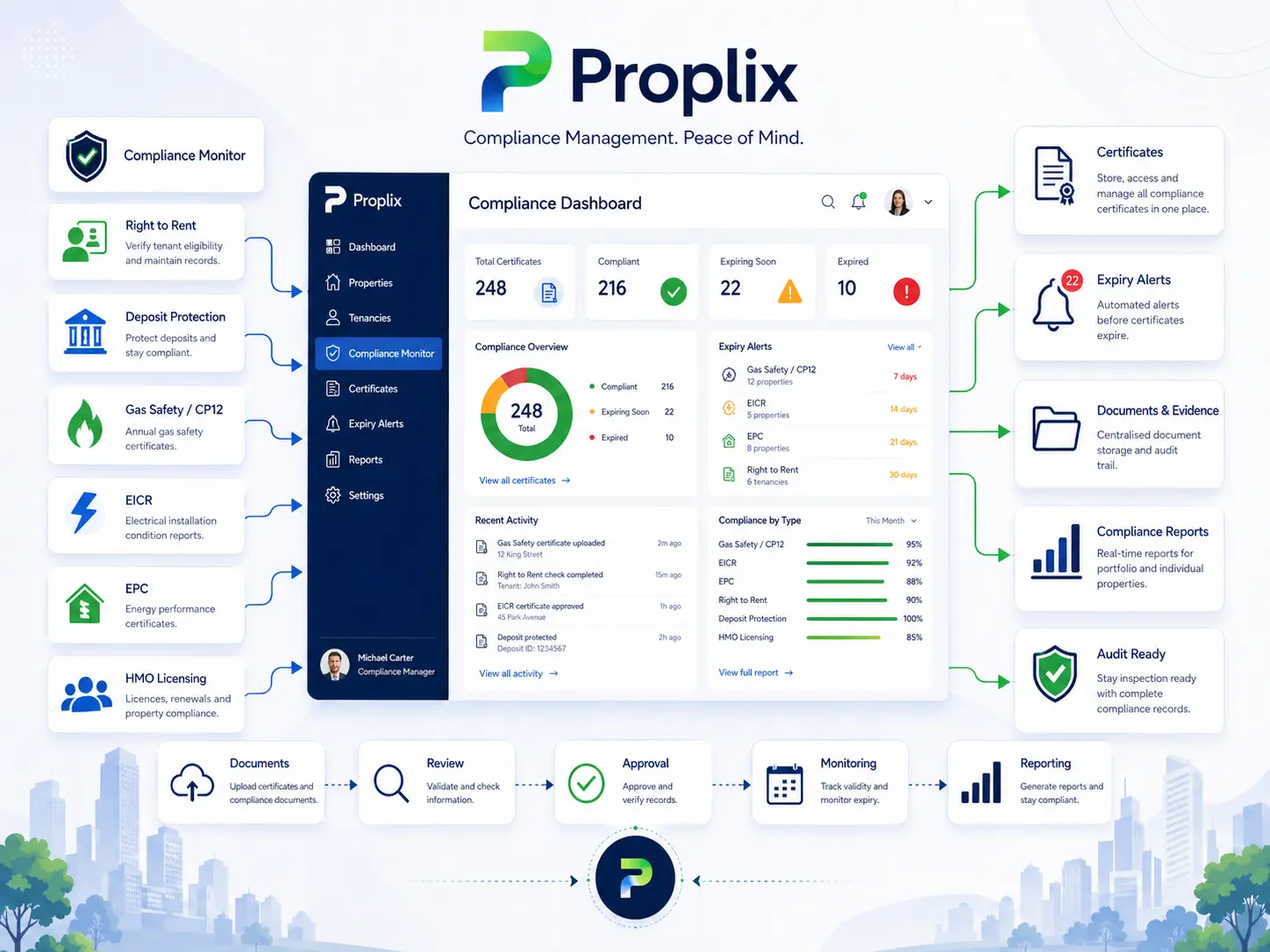
Platform illustration
A visual view of the compliance operating layer
Compliance in Proplix is a live working layer with records, evidence, reminders, accountability and reporting—not only a static document archive.
Operational compliance, with human judgement
How Compliance fits into dependable property operations
The strongest starting point is the work people actually complete, including the exceptions that rarely appear in a process diagram. Compliance software can organise dates, records, evidence, reminders and review stages, but it does not replace competent professional judgement. The workflow should make the current position visible and give authorised people enough context to decide what happens next.
Give each role enough context to act
Staff may collect information, reviewers may validate it and managers may approve an exception or escalation. Separating those responsibilities through permissions and recorded actions helps an organisation demonstrate how a conclusion was reached. For Compliance, that means access should follow an evidenced business need and change when responsibility changes.
Keep the reason beside the action
A defensible record connects the relevant property or party, the source evidence, review notes, dates, communications and final outcome. If information is rejected or incomplete, the reason and next action should be visible rather than buried in an email thread. This makes the Compliance record more useful during absence, escalation, service review or a later audit.
Design for the case that does not fit
Property work includes incomplete forms, late evidence, changed instructions, unavailable suppliers and circumstances requiring discretion. The system should expose those exceptions, preserve notes and direct them to an authorised person instead of silently forcing a misleading “complete” status.
Configure from representative work
Configuration should follow the organisation’s documented policy and the current advice of its legal, regulatory or compliance professionals. Test normal renewals alongside late documents, conflicting evidence, failed checks and cases requiring a manual decision. Document what remains outside the system as well, so teams understand the boundary between Proplix, connected services and professional responsibility.
Measure whether the work is improving
Monitor overdue reviews, incomplete evidence, unresolved exceptions, repeat failures and the time needed to assemble an audit trail. Management reporting should support intervention without presenting a software status as a substitute for legal assurance. Review findings with the people completing Compliance work, because a dashboard may not reveal the manual workaround being used beside it.
Keep guidance, permissions and records current
Ownership, legislation, services and internal policies change. Schedule periodic checks of access, templates, notifications, integrations and retained information. Record material changes and brief affected users so the configured workflow continues to reflect the organisation’s approved way of working.
Proplix supports structured workflow and evidence handling; it does not provide legal advice or remove the need for competent human review. Discuss your organisation, migration or integration requirements through the central secure enquiry route.
Discuss Compliance requirements →What a well-run Compliance process should make clearer
A member of staff opening the record should be able to understand its purpose, current status, owner and next meaningful action without first asking several colleagues for background. That does not mean every case follows an identical path. It means the agreed route is visible, departures are explained and supporting material remains beside the decision it informed. For Compliance work, clarity is especially important when the case moves between teams or returns after a period of inactivity.
The day-to-day experience should also make uncertainty honest. Missing evidence, a disputed instruction or a review awaiting specialist input should be shown as an exception, not hidden behind a reassuring colour or forced completion state. Managers can then direct attention where it is useful, while staff retain a record of the checks already completed. This approach supports a more natural conversation with landlords, tenants, suppliers, clients and colleagues because updates come from a current operational record rather than a hurried reconstruction.
Good information design reduces unnecessary detail without removing useful context. Labels should use the language the organisation actually understands; permissions should reflect real responsibilities; and notifications should be reserved for events that require awareness or action. When every minor system event generates an alert, important work becomes harder to see. A considered Compliance configuration therefore balances automation with judgement and gives authorised users a practical way to explain, reassign or escalate unusual work.
Implementation is not finished when data has been imported or users have received a login. Teams need time to test live examples, compare the configured route with policy, correct weak source information and agree how questions will be handled after launch. Early reviews should look for duplicated entry, private spreadsheets, unclear ownership and steps that users routinely bypass. Those observations are useful evidence: they show where the design, training or operating decision still needs attention rather than placing all responsibility on the person using the system.
Over time, the organisation should be able to show whether Compliance work is becoming easier to complete and easier to explain. Useful evidence may include fewer avoidable chasers, faster retrieval, more complete handovers, better-quality submissions and a smaller backlog of unresolved exceptions. Measures should be read alongside real cases and user feedback. Proplix provides the connected workspace for that improvement, while accountable people remain responsible for policy, professional decisions and the service ultimately delivered.